

Red and irritated eyes after eyelash extensions
Red eyes after an eyelash extension are generally not a cause for concern and occur frequently—but swollen eyelids are a different story. Why you should pay close attention and how to recognize an allergic reaction after lash extensions, we reveal in this blog post.
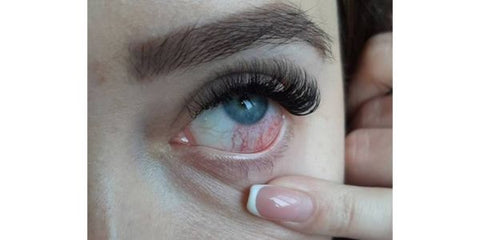
There are many reasons for red eyes after an eyelash extension, and it is almost always necessary for both the client and the lash stylist to work together to identify the cause.
Since clients often only return the next day for their follow-up appointment, it makes sense for those who are not lash specialists to inform themselves more thoroughly.
Why do some people have red eyes after lash extensions?
1. Adhesive
Almost every common adhesive in the world of eyelash extension contains cyanoacrylate. When this dries, formaldehyde is produced.
Formaldehyde is not listed as an ingredient in lash adhesive, but it is a byproduct that forms as the glue evaporates.
This gas irritates the eye. Thus, adhesives with less cyanoacrylate produce less formaldehyde, reducing irritation.
Other adhesives use alkoxyester-cyanoacrylates, which emit fewer fumes and odors.
Very cheap and often poorly manufactured adhesives may have strong bonding performance but produce extremely high vapor emissions.
These not only cause red eyes for the client but are also very irritating and harmful to the stylist’s respiratory tract. Therefore, using high-quality materials is essential.
Redness from the adhesive is probably the most common cause of irritated eyes after lash extensions. A lash stylist should therefore first consider switching to a different adhesive if needed.
Our recommendations:
Iconic by BLACKNESS

Why ICONIC?
The main reason for red eyes is the exposure time: the longer the eyes are exposed to adhesive fumes, the redder they become.
Iconic by Blackness has an incredibly fast cure time of 0.5 seconds. This means that not only is the application of individual fans much faster, but the overall procedure time is also shorter.
Shop Iconic
Forever by BLACKNESS

Why Forever?
Forever by Blackness also reduces exposure thanks to an incredibly fast cure time of 1 second. Like Iconic, Forever undergoes multiple filtration stages to further reduce fumes.
Shop Forever
2. Allergic Reaction
It’s important to know: An allergy is neither the client’s fault nor the stylist’s.
Nevertheless, it is crucial to recognize the symptoms of an allergic reaction to lash extensions immediately and act quickly.
If there is swelling around the eye area or the eyelid, the likelihood of an allergy is high.
Swelling, redness, and rashes of the skin can also be indicators!

Allergic reactions usually come with swelling or redness!
In this case, the eyelash extensions must be removed immediately to provide relief. If there is no improvement after several hours or further complications arise, a doctor must be consulted.
Allergic reactions vary widely and must be evaluated individually.
For example, some clients react mildly to hydrogel under-eye pads or tape, while others experience severe itching or pain from the adhesive.
For clients who have never had lash extensions before—especially those with other allergies—it is advisable to perform a patch test on all materials beforehand and observe for complications.
NEW: UV Eyelash Adhesive
UV adhesives are glues that have recently been used in the eyelash extension industry. These adhesives only cure when exposed to UV light. This means the stylist decides exactly when the adhesive activates.
This offers the following advantages:
a. The stylist does not have to hold the fans against the natural lashes and wait for the glue to cure in open air.
b. The adhesive emits fewer fumes in open air, since a single drop can complete an entire set.
c. More control and generally shorter application times—thus less time exposed to fumes.
Our recommendation:
Ultra Violet by Blackness
Because Blackness’s UV adhesive maintains a natural lightness and softness even after curing, providing clients with an incredibly natural wearing experience.
What is a Patch Test?
Apply small amounts to a selected area of skin and check whether your clients experience any reactions.
Learn more about allergic reactions to eyelash extensions here:
https://allergiefreie-allergiker.de/allergien/wimpernkleber-allergie/
3. Inferior Lashes
Many lash stylists do not realize they are using low-quality lashes made from the cheapest PBT or exposed to contaminants during manufacturing.
Thus, the choice of lashes can also play a significant role in ensuring a complication-free lash session.
If you want to avoid risk when purchasing lashes, we recommend BLACKNESS lashes!
Link: https://www.pittnoir.at/collections/blackness/products/blackness-lashes-mix
These lashes are manufactured under high standards, are hypoallergenic, and in our opinion are the best currently on the market.
4. Dry Eyes
Another very common reason for red eyes is that the eyes become too dry during the treatment.
This can be due to the adhesive, which may draw moisture from the environment as it cures.
Also, isolating the lower lid can prevent the eyes from closing fully and thus from properly moistening.
In most cases, eye drops or gel provide relief—before, during, and after the procedure, depending on symptom severity. Lash stylists should advise clients prone to dry eyes to bring their own eye drops to the appointment.
Of course, drops may only be used during the procedure in consultation with the stylist, and fresh extensions must be handled carefully to avoid contact with moisture.
5. Poor Isolation of Lashes
Especially stylists with less experience often place isolation pads and tape incorrectly.
A lash artist must ensure that no isolation touches the mucous membrane or the sclera itself, as this causes eye irritation and maximum discomfort for the client.
Some clients have a genetic predisposition to red eyes. For these clients, silicone pads may be recommended.
6. Poor Hygiene
What every lash stylist should know but often neglects in practice: Cleaning, disinfecting, and sterilizing all instruments and tools is an absolute must!
To prevent bacteria and contaminants from one client transferring to the next, it’s essential to thoroughly clean, disinfect, and, if necessary, sterilize tweezers, reusable eye pads, treatment beds, and hands after each client.
If these steps are not followed, an infection may develop after the eyelash extension that requires treatment.

For clients: To avoid an eye infection after an eyelash extension, look for clean instruments at your stylist’s and feel free to ask how they are sanitized. Your eyes are at stake—caution comes first!
7. Red Eyes from Careless Technique
Improper or careless handling of tools like tweezers can certainly cause eye redness—for example, if a sharp tweezer tip contacts and injures the eye.
Professional lash stylists are trained in proper instrument use.
If such an incident does occur, an ophthalmologist should be consulted for safety.
8. Contact Lenses
A common belief is that contact lenses protect the eyes from adhesive fumes—and this is often true.
However, there is also a condition called “Contact Lens Acute Red Eye.”
This phenomenon describes eye dryness when contact lenses are worn while the eyes remain closed for an extended period.
So, while some clients may benefit from keeping their lenses in, others are better off removing them before the treatment. Lash stylists should inform clients so they arrive appropriately prepared.
9. Talking During the Extension Process
While light conversation may be okay for some beauty procedures, lash extensions are different.
Movement of facial muscles extends the treatment time because it makes it harder for the stylist to work. These movements also slightly open the eyes, increasing exposure to fumes and isolation. A longer procedure means more time exposed to fumes.

The image shows a slightly open eyelid, likely because there was talking during the procedure.
10. Poor Workmanship by the Stylist
The quality of service varies dramatically from stylist to stylist. Many clients lack the knowledge to distinguish poor work from good, often leading to negative experiences.
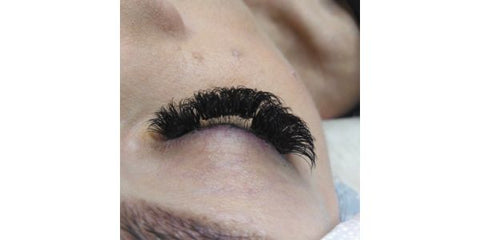
What is a bad eyelash extension?
There are many ways to do eyelash extensions poorly. In relation to red eyes, using too much adhesive and clumping the lashes directly against the eyelid can cause itching and irritation, leading to redness or causing the client to rub the area and further irritate the eyes.
How long do eyes stay red after an eyelash extension?
This varies from person to person and depends greatly on the cause of the symptoms.
For example, irritation due to the adhesive should subside within a few hours but in some cases may last longer.
If the eye has been injured, recovery depends on the severity of the injury.
In general:
If the eyes remain unusually red for an extended period, a medical consultation is necessary to rule out all possibilities.
If necessary, the eyelash extensions must be removed.
What else can be done to prevent red eyes?
Some clients take an antihistamine before their appointment or use corticosteroid creams to prevent mild allergic reactions. However, these should never be used without medical advice!
Some stylists, instead of priming the eyes, use saline solution for clients with sensitive, easily irritated eyes.
We are not medically trained, so we cannot recommend the above tips!
Consultation with qualified medical professionals is required.
Regularly ventilating the workspace with a fan can also help alleviate red and irritated eyes during the eyelash extension process.
Summary:
What can stylists do to prevent redness and irritation?
1. Use high-quality lash adhesive
2. Patch-test materials on clients
3. Recommend eye drops for clients with dry eyes
4. Isolate properly
5. Maintain strict hygiene
6. Handle tweezers carefully
7. Advise about contact lenses
8. Avoid conversation during application
9. Apply clean, proper lash extensions
Bonus: If a client experiences prolonged red eyes, they should return for a follow-up so an allergy can be ruled out and the risk of conjunctivitis assessed.
Finally, there are many reasons for tearing, irritation, or redness after eyelash extensions.
Allergic reactions are fortunately rare.
Mild redness usually subsides within a few hours and is generally harmless.
With the tips mentioned, you may prevent or at least reduce this symptom for some clients.